
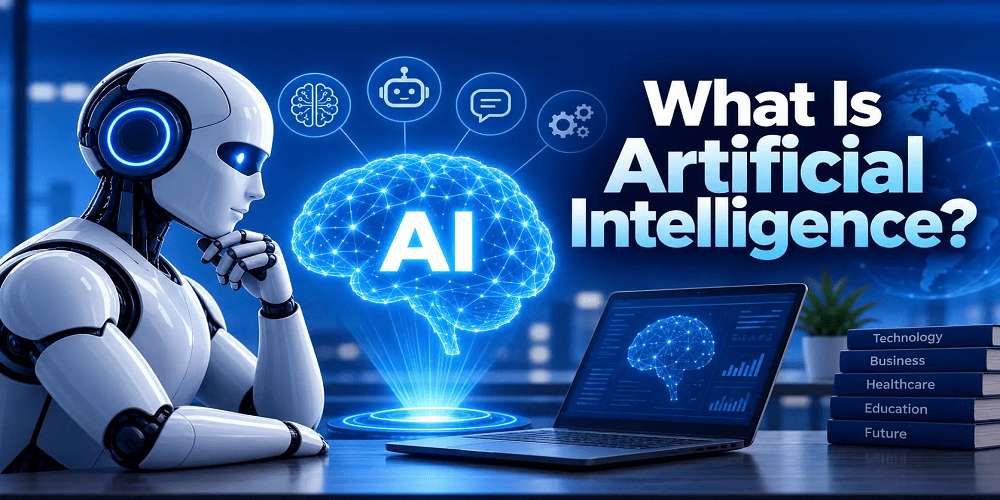
Artificial Intelligence (AI) has become one of the most important technologies in the modern world. From smartphones and search engines to healthcare, education, banking, and transportation, AI is changing how people live, work, and communicate. Businesses, governments, and individuals are increasingly using intelligent systems to complete tasks faster, analyze information, and make better decisions.
In recent years, artificial intelligence has developed rapidly. Tools powered by AI can generate written content, create images, translate languages, recognize voices, answer questions, and solve complex problems. Technologies such as chatbots, virtual assistants, recommendation systems, and self-driving vehicles are practical examples of how AI is becoming part of everyday life.
Artificial intelligence is not limited to large technology companies. Small businesses, students, professionals, content creators, and entrepreneurs can also use AI-powered tools to improve productivity and save time.
However, this technology also creates important questions about privacy, security, employment, accuracy, and responsible use. Understanding how artificial intelligence works, where it is used, and what its future may look like can help people make better decisions in an increasingly digital world.
This guide explains the meaning of artificial intelligence, its different types, major applications, advantages, disadvantages, and future possibilities.
What Is Artificial Intelligence?
Artificial intelligence is a branch of computer science that focuses on developing machines and software capable of performing tasks that normally require human intelligence.
These tasks may include learning, reasoning, understanding language, recognizing images, identifying patterns, solving problems, and making predictions.
Traditional computer programs generally follow instructions written by developers. In comparison, many modern AI systems can learn patterns from data and use those patterns to produce results or predictions.
For example, when someone searches for a product online, an AI-powered recommendation system may analyze previous searches, browsing behavior, and purchasing patterns to suggest relevant products.
Similarly, voice assistants can recognize spoken commands and respond with useful information.
Artificial intelligence does not necessarily think or understand the world in the same way humans do. It processes information using mathematical models, algorithms, and computational systems.
The primary objective of AI is to develop technology that can perform specific intelligent tasks efficiently and consistently.
How Does Artificial Intelligence Work?
Artificial intelligence works through a combination of data, algorithms, computing power, and mathematical models. Different AI technologies use different approaches, depending on the task they are designed to perform.
Here are the main stages involved in how AI systems work.
1. Data Collection
Data is the foundation of many AI systems. Machines require information to identify patterns, learn relationships, and generate useful results.
Data can come from different sources, including websites, documents, images, videos, sensors, customer interactions, and databases.
For example, an AI system designed to recognize photographs may be trained using thousands or millions of labeled images.
2. Data Processing
After collecting information, the system processes the data to make it suitable for learning.
This stage may involve removing incorrect information, organizing records, identifying missing values, and converting information into a format that algorithms can understand.
High-quality data is important because inaccurate or biased training information can produce unreliable results.
3. Machine Learning
Machine learning is an important part of artificial intelligence.
It allows computer systems to identify patterns in data and improve their performance through experience rather than depending entirely on manually written instructions.
For example, an email filtering system can learn to identify spam messages by analyzing common characteristics of unwanted emails.
4. Model Training
During training, an AI model processes examples and adjusts its internal parameters to improve its predictions or outputs.
The training process may require powerful computers, specialized hardware, and large datasets.
Once training is complete, the model can be used to process new information.
5. Generating Results
After learning from data, an AI system can perform its assigned task.
It may generate text, recognize an object, recommend a product, predict demand, or answer a question.
The quality of its output depends on the model, training information, instructions, and available context.
Types of Artificial Intelligence
Artificial intelligence can be classified according to its capabilities and functionality. Understanding these categories helps explain the differences between current AI systems and more advanced theoretical technologies.
1. Narrow Artificial Intelligence
Narrow AI, also known as weak AI, is designed to perform specific tasks.
Most artificial intelligence systems currently used in everyday life belong to this category.
Examples include:
- Voice assistants that respond to spoken commands.
- Recommendation systems that suggest movies and products.
- Facial recognition software.
- Email spam detection systems.
- AI chatbots that answer customer questions.
- Navigation applications that suggest routes.
Narrow AI can perform certain tasks extremely well, but it does not possess general human intelligence.
For example, an AI system trained to recognize medical images cannot automatically become an expert in financial planning without additional development and training.
2. General Artificial Intelligence
Artificial General Intelligence (AGI) refers to a theoretical form of AI that could understand, learn, and perform a wide variety of intellectual tasks at a level comparable to human intelligence.
Unlike narrow AI, general AI would not be restricted to one specific task.
It could potentially transfer knowledge between different subjects, solve unfamiliar problems, and adapt to new situations.
However, genuine AGI remains an unsolved research goal. Today's advanced AI systems should not automatically be considered human-level general intelligence.
3. Super Artificial Intelligence
Artificial Superintelligence (ASI) is a hypothetical form of intelligence that would exceed human intellectual abilities across nearly all areas.
It could potentially outperform humans in scientific research, strategic planning, problem-solving, and technological innovation.
Superintelligence remains a theoretical concept rather than an existing practical technology.
Researchers continue to discuss its potential opportunities, risks, and implications for society.
Major Applications of Artificial Intelligence
Artificial intelligence is being used across many industries. Its ability to analyze information, automate repetitive activities, and identify patterns makes it useful for organizations of different sizes.
1. Artificial Intelligence in Healthcare
Healthcare is one of the most important areas where AI can provide valuable support.
AI-powered systems can help medical professionals analyze medical images, identify possible health risks, organize patient information, and support research.
Some important applications include:
- Medical image analysis.
- Early identification of certain diseases.
- Patient data management.
- Drug discovery and development.
- Hospital administration.
- Medical research assistance.
For example, AI systems can help radiologists examine X-rays, CT scans, and MRI images for unusual patterns.
However, AI-generated medical information should not replace professional medical judgment. Healthcare decisions require qualified professionals and appropriate clinical evaluation.
2. Artificial Intelligence in Education
Education is changing through the introduction of intelligent learning technologies.
Students can use AI tools to understand difficult subjects, practice languages, summarize educational material, and receive explanations.
Teachers can also use AI to prepare learning resources, develop practice questions, and organize educational content.
Major applications include:
- Personalized learning.
- AI-powered tutoring systems.
- Language translation.
- Automated assessment support.
- Educational content creation.
- Student performance analysis.
For example, an AI tutor can explain a mathematical concept using simpler language when a student struggles to understand it.
Artificial intelligence can support education, but students should continue developing their own research, writing, and critical-thinking skills.
3. Artificial Intelligence in Business
Businesses are increasingly adopting artificial intelligence to improve productivity and customer experiences.
AI tools can analyze customer behavior, process large amounts of information, automate repetitive work, and support business planning.
Some common business applications include:
- Customer service chatbots.
- Sales forecasting.
- Customer behavior analysis.
- Inventory management.
- Automated reporting.
- Business process optimization.
For example, an online shopping company can use AI to recommend products based on customer interests and previous purchases.
Small businesses can also benefit from affordable AI tools without investing in expensive technology infrastructure.
4. Artificial Intelligence in Digital Marketing
Digital marketing is another industry experiencing major changes because of artificial intelligence.
Marketers can use AI-powered platforms to understand audiences, research keywords, analyze campaign performance, and develop content ideas.
Important applications include:
Keyword Research: AI tools can help identify relevant search terms, understand search intent, and organize keyword opportunities.
Content Creation: AI writing assistants can help generate outlines, draft content, improve grammar, and suggest relevant topics.
Advertising Optimization: AI can analyze campaign performance and help advertisers improve targeting, bidding, and budget allocation.
Customer Segmentation: Businesses can group customers according to interests, behavior, and purchasing patterns.
Performance Analysis: AI-powered analytics can help identify trends and explain changes in website traffic or campaign results.
However, AI-generated content should always be reviewed for originality, accuracy, usefulness, and relevance. Publishing large amounts of unedited or low-quality content does not guarantee better search rankings.
5. Artificial Intelligence in Banking and Finance
Financial institutions use artificial intelligence to analyze transactions, improve customer service, and identify suspicious activities.
AI-powered fraud detection systems can examine transaction patterns and identify unusual behavior that may require further investigation.
Other applications include:
- Fraud detection.
- Risk assessment.
- Customer support.
- Financial forecasting.
- Credit analysis.
- Automated transaction monitoring.
For example, a banking system may identify an unusual transaction based on spending patterns and request additional verification.
AI can make financial services more efficient, but financial institutions must also ensure data security, fairness, and regulatory compliance.
6. Artificial Intelligence in Transportation
Transportation companies are exploring AI to improve road safety, vehicle performance, and traffic management.
AI technologies are used in navigation systems, driver assistance features, traffic prediction, and autonomous vehicle research.
Examples include:
- Route optimization.
- Traffic forecasting.
- Driver assistance systems.
- Vehicle monitoring.
- Predictive maintenance.
- Autonomous driving research.
Navigation applications can analyze traffic conditions and suggest alternative routes to reduce travel time.
Although self-driving technology continues to develop, fully autonomous transportation still faces technical, legal, and safety challenges.
7. Artificial Intelligence in Entertainment
Entertainment platforms use AI to understand user preferences and recommend relevant content.
Streaming services can analyze viewing history, ratings, and user behavior to suggest movies, television shows, and music.
AI is also being used in:
- Image generation.
- Video editing.
- Music production assistance.
- Animation.
- Gaming experiences.
- Content recommendations.
These technologies provide creators with new ways to develop digital content and improve production workflows.
Popular Artificial Intelligence Tools
Several AI-powered platforms are available for personal and professional use. Each tool offers different capabilities depending on its purpose.
ChatGPT
ChatGPT is an AI assistant that can help users answer questions, write content, summarize information, generate ideas, and understand complex topics.
It can also assist with coding, research, translation, and everyday productivity tasks.
Google Gemini
Google Gemini is an AI platform that supports tasks such as information analysis, content generation, reasoning, and productivity.
It can help users work with different types of information depending on the available features.
Microsoft Copilot
Microsoft Copilot provides AI-powered assistance for writing, research, productivity, and certain Microsoft applications.
It can help users summarize information, generate content, and complete everyday workplace tasks.
Claude
Claude is an AI assistant designed for tasks such as writing, document analysis, coding, and reasoning.
It can be useful for working with lengthy documents and organizing complex information.
Midjourney
Midjourney is an AI image-generation platform that creates visual artwork from written prompts.
Designers and creative professionals can use it to explore visual concepts and generate artistic images.
These tools have different strengths, pricing models, and usage limitations. Users should select platforms according to their actual requirements.
Benefits of Artificial Intelligence
Artificial intelligence offers several advantages for individuals, businesses, and organizations.
1. Saves Time
AI can automate repetitive activities such as organizing information, generating summaries, and processing routine requests.
This allows people to focus on more important responsibilities.
2. Improves Productivity
Employees can use AI assistants to complete certain tasks faster and organize their daily work more effectively.
For example, a marketing professional can use AI to prepare campaign ideas and analyze performance data.
3. Processes Large Amounts of Data
AI systems can analyze large datasets and identify patterns that may be difficult for humans to recognize manually.
This capability is valuable in research, finance, healthcare, and business operations.
4. Supports Better Decisions
AI-powered analytics can provide useful insights that help organizations evaluate opportunities and risks.
However, final decisions should consider human judgment and additional evidence.
5. Provides Personalized Experiences
Recommendation systems can suggest products, entertainment, and educational resources based on user interests.
This can improve the overall experience of digital services.
6. Reduces Certain Operational Costs
Automation can reduce the time required for repetitive business processes.
Organizations may use AI to manage routine customer requests, prepare reports, and improve operational efficiency.
Disadvantages and Challenges of Artificial Intelligence
Despite its advantages, artificial intelligence also creates several challenges that individuals and organizations should understand.
1. Job Displacement
Automation may reduce the demand for certain repetitive tasks.
Some roles involving basic data entry, routine customer support, and administrative work may change as businesses adopt AI systems.
However, AI can also create new opportunities in software development, data analysis, AI management, and technology-related industries.
Workers may need to develop new skills to adapt to changing employment requirements.
2. Privacy Concerns
AI systems may process personal information, business records, and sensitive data.
If information is collected or stored improperly, it can create privacy and security risks.
Organizations should follow applicable data protection laws and use appropriate security practices.
3. Incorrect Information
AI systems can sometimes generate incorrect answers, misleading explanations, or fabricated details.
This is especially important when using AI for medical, financial, legal, or other high-impact decisions.
Users should verify important information through reliable sources.
4. High Development Costs
Building and maintaining advanced AI systems can require expensive hardware, software, technical expertise, and infrastructure.
Smaller organizations may find it difficult to develop their own AI solutions.
5. Bias and Unfair Results
AI systems learn from training data. If that information contains existing biases, the system may produce unfair or discriminatory results.
Regular testing, human oversight, and representative datasets can help reduce these risks.
6. Security Risks
AI technology can potentially be misused for phishing, misinformation, impersonation, and other harmful activities.
Organizations must implement security measures and educate users about responsible technology use.
Artificial Intelligence vs. Machine Learning
Artificial intelligence and machine learning are closely related concepts, but they are not exactly the same.
Artificial intelligence is the broader field of developing systems that can perform tasks associated with human intelligence.
Machine learning is a specific approach within AI that allows systems to learn patterns from data.
For example, an AI-powered email application may use machine learning to identify spam messages based on previously analyzed emails.
Deep learning is another specialized area within machine learning. It uses neural networks with multiple layers to process complex information such as images, audio, and text.
In simple terms, artificial intelligence is the larger concept, while machine learning and deep learning are technologies that help make many AI applications possible.
The Future of Artificial Intelligence
The future of artificial intelligence is expected to bring further developments across technology, business, healthcare, education, and other industries.
As AI models become more capable, organizations may increasingly use intelligent systems to support complex workflows and improve productivity.
Some important developments to watch include the following.
1. More Advanced AI Assistants
AI assistants may become better at understanding instructions, working with documents, and helping users complete multiple tasks.
They could become more integrated into everyday software and business operations.
2. Growth of AI in Healthcare
Future healthcare applications may include improved medical image analysis, research support, and personalized treatment planning.
These developments will require careful testing, clinical validation, and professional oversight.
3. AI-Powered Automation
Businesses may increasingly automate repetitive workflows using intelligent systems.
This could improve efficiency in manufacturing, customer support, logistics, and administration.
4. Personalized Education
AI-powered educational platforms may provide learning experiences that adapt to individual student needs.
Students could receive additional explanations and practice exercises based on their learning progress.
5. Human and AI Collaboration
Rather than replacing every human activity, many AI systems are likely to work alongside people.
Human creativity, communication, judgment, and accountability will remain important in many professional roles.
6. Responsible AI Development
As artificial intelligence becomes more widely used, governments, companies, and researchers will need to address issues involving privacy, transparency, security, fairness, and accountability.
Responsible development will be essential for building public trust.
How Can Beginners Learn Artificial Intelligence?
Learning artificial intelligence does not necessarily require an advanced technical background. Beginners can start by understanding basic concepts and gradually developing practical skills.
Here are some useful steps:
Step 1: Understand Basic Computer Concepts
Learn how computers process information, store data, and execute instructions.
Step 2: Learn Basic Mathematics
Develop an understanding of statistics, probability, and basic algebra. These subjects are useful for understanding machine learning.
Step 3: Learn Python Programming
Python is widely used in AI and machine learning development. Beginners can start with variables, functions, loops, and data structures.
Step 4: Explore Machine Learning
Study basic concepts such as supervised learning, unsupervised learning, classification, and regression.
Step 5: Practice with AI Tools
Experiment with AI assistants, image generators, and data analysis platforms to understand their practical capabilities.
Step 6: Build Small Projects
Try creating simple projects such as a spam email classifier, chatbot, recommendation system, or basic prediction model.
Step 7: Continue Learning
AI technology changes quickly. Following educational resources, documentation, and practical tutorials can help learners stay updated.
Consistency and practical experience are more valuable than trying to understand every advanced concept immediately.
Conclusion
Artificial intelligence is transforming the modern world by changing how people work, communicate, learn, and solve problems. From healthcare and education to finance, transportation, and digital marketing, AI technologies are creating new opportunities for individuals and organizations.
Its ability to analyze information, automate repetitive tasks, and support decision-making makes it an important part of modern technology.
However, artificial intelligence also comes with challenges involving privacy, employment, security, bias, and accuracy. Understanding these limitations is essential for using AI responsibly.
The future of artificial intelligence will likely involve greater collaboration between humans and intelligent systems. People who understand AI and develop relevant skills may find new opportunities as technology continues to evolve.
Rather than viewing AI only as a replacement for human work, it is useful to understand it as a technology that can support human creativity, productivity, and problem-solving.
Frequently Asked Questions (FAQs)
1. What is artificial intelligence in simple words?
Artificial intelligence is a technology that enables computers and machines to perform tasks that usually require human intelligence. These tasks include learning, problem-solving, recognizing images, understanding language, and making predictions.
2. What are the main types of artificial intelligence?
The three commonly discussed capability-based categories are Narrow AI, Artificial General Intelligence (AGI), and Artificial Superintelligence (ASI). Narrow AI is widely used today, while AGI and ASI remain theoretical goals.
3. What are some common examples of artificial intelligence?
Common examples include ChatGPT, Google Gemini, voice assistants, facial recognition, recommendation systems, spam filters, AI image generators, and navigation applications.
4. Can artificial intelligence replace human jobs?
Artificial intelligence can automate certain repetitive tasks and change the responsibilities of some professions. However, it can also create new job opportunities in areas such as AI development, data analysis, cybersecurity, and technology management. Human skills remain important.
5. How can I learn artificial intelligence as a beginner?
Beginners can start by learning basic computer science, mathematics, and Python programming. They can then explore machine learning concepts, experiment with AI tools, and build simple projects to gain practical experience.
Leave A Comment
0 Comment